


Mitsuba Pallet


Mitsuba pallet
The world's first innovative pallet optimized for transporting tires and open drums.
The Mitsuba pallet was designed to eliminate, to the greatest extent possible, the "dead space" that was unavoidable in conventional pallet transport. Its unique patented structure dramatically improves loading efficiency and minimizes transportation costs.
Components
① FIX3RD (Cup Saddle)
These are the leg components. Two types are available: cup height of 100mm and 55mm.
② Mitsuba clover plate (surface material)
I am using particleboard.
Insert the cup saddle into the Mitsuba plate and lock it in place with a fully threaded iron screw from above.
When we deliver the product, we can either deliver it as a fully assembled product or as an unassembled (disassembled) product to make efficient use of transport space.
Part 1
FiX3RD
Part 2
Mitsuba plate
Mitsuba Pallet

+

■ Easy to move and load
Because the pallets fit together perfectly, you do not need any special skills to use them with a hand pallet truck. Anyone can load and move cargo quickly and easily.
■ Demonstration of the use of a Mitsuba pallet forklift
■Mitsuba pallet explanatory video
Mitsuba Pallet design
■ Designed to match the curves of tires and drums
■ There is plenty of space to keep the drums from hitting each other.
■ Fits snugly like a puzzle, allowing for safe stacking
■ Locking function ensures safety during loading
■ High load capacity (up to approximately 2 tons)
■Improved loading efficiency. 12 sheets can be loaded into a 20-foot container, stacked in two layers. A maximum of 24 trays can be loaded.
■ Reduced loading and unloading time

■ Three-leaf type pallet for tires + FIX3RD
Mitsuba pallet type
■ Mitsuba-flange pallet for drums + perforated legs (for refrigerated transport)


■ Three-flange type with caster legs for drums


Challenges of open drums
Transporting open drums comes with many difficulties. Some issues are minor enough to be overlooked due to a lack of better options, while others are serious enough to cause unnecessary expenses.
■ Loading time
Open drums must be carefully handled and secured when loading to avoid accidents. Currently, the most common way to transport drums is by loading them one by one. This usually requires two workers to use a forklift to move the drums into place. While this method fits many drums in a truck, it takes a lot of time and hard work.

■ Safety issues
Transporting drums is difficult because they can shift during transit. They also often get dented or damaged due to bumps and impacts.
■Drum size
Some companies use pallets to speed up loading. However, for open drums, the ring lock makes the drum wider than a closed drum. This reduces how many can fit in a container. For example, while you can fit four closed drums side-by-side, you can only fit three open drums.


If it's the Mitsuba Palette!!
With a three-leaf pallet, you can not only shorten loading time, but also ensure safe transport thanks to its locking mechanism.
Furthermore, the pallet size can be customized to match the size of the drums.
The following is a comparison table of drum loading times. By combining the advantages of palletized loading, we can maximize loading capacity while shortening loading time. For loading into a 20-foot container, manual loading takes approximately 2 hours and 40 minutes for 38 drums, palletizing takes approximately 55 minutes for 16 drums, and using a three-leaf pallet takes approximately 30 minutes for 36 drums.


When to use an open drum
-
For solid materials (powder, resin, or food ingredients).
-
For thick, sticky liquids (like grease or paste).
-
When you need to put the contents in from the top.
■Differences in loading efficiency (affects the number of items in a container)
Open drum
-
The protruding ring creates dead space.
-
Fewer items can fit in the same container.

Closed drum
• Flat surface makes it easy to align.
• Can carry the maximum number of items.

■Differences in safety
Open drum
-
The metal ring can damage neighboring drums.
-
Damage can lead to holes and leaks, which can cause serious accidents if chemicals are involved.
-
Extra care is necessary when transporting by sea.
Closed drum
-
Because there are no metal fittings on the outside, the risk of collision damage is low.
-
This makes them suitable for transporting dangerous goods.
The difference between open drums and closed drums
■ Open Head Drum
• Type with a completely removable top lid
• A metal ring is attached to the outside to secure the lid.
• The bolt portion of the ring protrudes outwards.
■ Closed Drum (Tight Head Drum)
- The top is welded and cannot be opened.
- It has only two inlet ports (bungee cords).
- The exterior is completely flat with no protrusions.
■Differences during loading and transportation
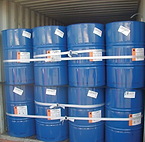
Problems with open drums The protruding rings hit other drums, so they cannot be lined up perfectly. This creates empty space. If you push them together tightly, the metal parts will rub against each other during transport. This can cause dents, holes, or leaks.
Advantages of closed drums The flat sides allow you to pack them tightly together. This makes loading more efficient and prevents them from hitting each other, even when they shake during transport.
■Differences in usage
What is a closed drum suitable for?
• Liquids (chemicals, solvents, oils)
• Hazardous materials (UN certified products)

Merit
• Maximum load capacity
Merits
-
Significant reduction in loading time: Reduces the amount of manual labor required.
-
Reduced physical workload: Makes tasks easier and safer for everyone, including women and the elderly.
-
Streamlined operations: Simplifies inventory management and inspection processes.
-
Improved turnover: Increases the speed and efficiency of inventory rotation.
Current Challenges
-
Storage location management: Requires specific tracking of where items are stored.
-
Reduced loading capacity: Fewer items can be loaded compared to other methods.
-
Return logistics: The three-tier PC pallets must be collected and returned for reuse.
Current Status and Challenges in Automotive Tire Transportation
Transporting automobile tires presents numerous challenges. Many of these have long been accepted as unavoidable,
but a significant number continue to generate unnecessary costs.
■ Flat storage (bulk stacking)


Current challenges
- Loading takes time and manpower (the same applies to the receiving end).
• The workload is extremely high.
- It's difficult for older drivers to handle, and younger drivers tend to avoid it.
- Waiting time charges apply. Due to the longer loading and unloading time, the number of trips that can be made per day is reduced.
■Structural differences


With a three-leaf pallet, loading time is drastically reduced!
By simply changing the shape of the pallet, tire transport can be significantly reduced in terms of loading time, cost, and driver burden. With a three-leaf pallet, you can load almost the same number of tires as with regular bulk loading, while reducing loading time to about one-third.
Simulation conditions
-
Transportation route: Factory to distribution center (approximately 50km one way, approximately 1 hour 30 minutes including waiting time)
-
Truck: 10-ton low-bed truck (width 2380 x height 2600 x length 9600 mm)
-
3-tier PC pallet: Width 1100 x Height 2350 x Depth 1100 mm
-
Tire size: Diameter 550-650mm, width 215mm
-
Loading and unloading time: Estimated at 30 minutes each.
-
A 10-ton truck can carry 900 empty pallets from Mitsuba, meaning collection is only needed once every 45 trips (collection by smaller trucks is also possible).

Summary: Three-leaf pallets can transport almost the same number of items in a single trip as bulk loading, at roughly the same cost. However, loading time is significantly reduced, lessening the burden on drivers. With two trips, you can transport more than 1.5 times the number of items transported with bulk loading, and the cost is nearly halved.
■Zero industrial waste (resource reuse)


With imports and exports accelerating worldwide and the demand for pallets continuing to expand, we are being forced to re-examine the very nature of logistics.
Introducing 3RD pallets (and trefoil pallets) is more than just a material replacement. It's a "smart investment" to maximize corporate profits while dramatically reducing industrial waste and contributing to local communities and the global environment.
We are confident that Fix3RD's solutions, which combine outstanding cost efficiency with environmental performance, will bring further growth and a sustainable future to your business.